
Emergency Water Damage Restoration Near Me: What Great Neck Plaza Homeowners Should Do First
If water is entering your Great Neck Plaza home right now, the first call you make should be to shut off the water source or the power. The second call should be to a restoration company that answers with a live person at any hour. At Floodline Restoration Co., that number is (518) 873-4306, and a dispatcher picks up at 2 a.m. the same way they do at noon. But before anyone arrives, the difference between a $6,000 dry-out and a $22,000 gut-and-rebuild comes down to four specific actions taken in the first 90 minutes.
Mold colony formation begins in as little as 24 hours in humid conditions. But the decisions that make mold inevitable are usually made in the first two hours, before any restoration crew arrives. Running the wrong fan, opening the wrong door, or disturbing standing water in a basement before knowing its source are the three moves that most reliably turn a contained incident into a gut-and-rebuild.
The First 90 Minutes: A Minute-by-Minute Action Checklist
Great Neck Plaza’s housing stock skews older, which means basements, crawl spaces, and subpanels in places a modern builder would never put them. The sequence below is built for those homes specifically. Print it and put it somewhere you can find it in the dark.
Minutes 0-15: Stop the Water, Not the Panic
Your first job is to stop water at its source. If it’s a burst supply line under a sink, turn the shutoff valve at that fixture. If you can’t find a fixture valve quickly, shut the main water valve where it enters the house, typically at the front wall of the basement or in a utility closet. If the water is coming from a sewage backup or storm drain, do not attempt to stop it and do not enter the water. More on why below.
Minutes 15-30: Kill the Power, Safely
Here’s the Great Neck Plaza reality that generic checklists miss: many homes in this village have electrical subpanels in the basement, which is exactly where water collects first. If water has reached the lower level and your panel is down there, treat the entire floor as energized until the utility company or a licensed electrician confirms otherwise. Do not wade in to flip a breaker. Call the utility’s emergency line from a dry floor and report the situation.
If your panel is on a dry upper floor and you can reach it without crossing water, shut off the breakers to affected rooms. But if there is any standing water below the panel line, or if you can’t see the panel without stepping into water, wait.
Minutes 30-45: Photograph Everything, In the Right Order
Insurance claims fail on documentation gaps. You want photos before you move a single piece of furniture or mop a single gallon. The order matters:
- Wide shots of each affected room from two angles.
- The source of the water itself, if visible (the failed supply line, the backed-up drain).
- Water level marks on walls, baseboards, doorframes, and the exterior foundation.
- Personal property from at least three feet back, so the adjuster can see condition and context.
- Serial numbers and model plates on appliances, water heaters, or HVAC equipment that got wet.
Keep photographing as water recedes or spreads. Time-stamped photos create a record that makes the adjuster’s job easier, and that speeds the claim.
Minutes 45-90: The Three Things You Must Not Do
This is where homeowners in Great Neck Plaza complicate their own recovery. Here are the three most damaging instincts and why you should resist them.
Do not open windows and run fans. In a Long Island summer, outdoor air carries more humidity than the air inside your flooded basement. Opening windows introduces moisture, not relief. Running a box fan over a wet floor spreads water vapor through the house and pushes it into drywall cavities where mold loves to hide. A professional-grade drying plan uses Floodline Restoration Co. home methods that meter airflow and humidity, not guesses.
Do not disturb standing water before knowing its category. Gray water from a washing machine or dishwasher carries bacteria but not sewage. Black water from a sewer backup or storm drain overflow carries pathogens that make any skin contact a medical risk. If you don’t know the source, treat it as black water. Stay out. That’s not overcautious; it’s the difference between a cleanup and a quarantine-grade biohazard job.
Do not pull up wet carpet or pad without a plan. Ripping out soaked material feels productive, but it breaks the water trail that tells an experienced crew where moisture traveled. It also releases contaminant-laden fibers into the air. Let the restoration crew see the damage the way it happened.
Clean Water vs. Gray Water vs. Black Water: Why the Response Protocol Is Different
Not all water damage is the same thing, and treating it as if it were is a health hazard. The restoration industry categorizes flood water into three classes, and the cleanup protocols for each are genuinely different.
Clean water comes from a burst supply line, an overflowing tub with clean tap water, or a failed water heater. This is the “best case” scenario. Extraction, drying, and dehumidification often save the flooring and drywall if started within hours. The response is fast, and reconstruction is often limited.
Gray water comes from washing machines, dishwashers, and clean toilet overflows. It contains soaps, food particles, and bacteria. The affected area needs antimicrobial treatment after extraction, and any porous material that absorbed the water is often disposed of rather than dried.
Black water comes from sewer backups, storm drain overflow, and any water that has been standing long enough to become a breeding ground. This water contains fecal matter, pathogens, and often chemical contaminants. The response is a full containment and disposal job. Carpet, pad, drywall, and sometimes lower wall framing come out. The space is disinfected before drying even starts.
In our experience in Great Neck Plaza, the most common misstep happens when a homeowner treats a sewer backup in a basement floor drain the same way they’d treat a burst supply line in the kitchen. They cross-contaminate the house moving soaked items from the basement to the garage, and the contamination spreads. The right protocol is containment first, questions later.
What to Say When You Call a Restoration Company at 2 A.M.
You’re standing in your kitchen, the water is rising in the basement, and you need a crew. What you say on this call determines what equipment arrives on the truck. Here’s what a good restoration company needs to know in the first 90 seconds:
- The water source, if you know it. Clean supply line? Sewage? Storm water? “I’m not sure” is an acceptable answer, but say it clearly so the crew plans for the worst case.
- How long the water has been present. Water that entered in the last hour is a different job than water that has been sitting overnight.
- Where the water is and how deep it stands. “Basement, three inches, and rising” tells the dispatcher to send extraction pumps, not just a moisture meter.
- Whether the power is off and whether anyone has entered the water. This protects the crew and saves time on arrival.
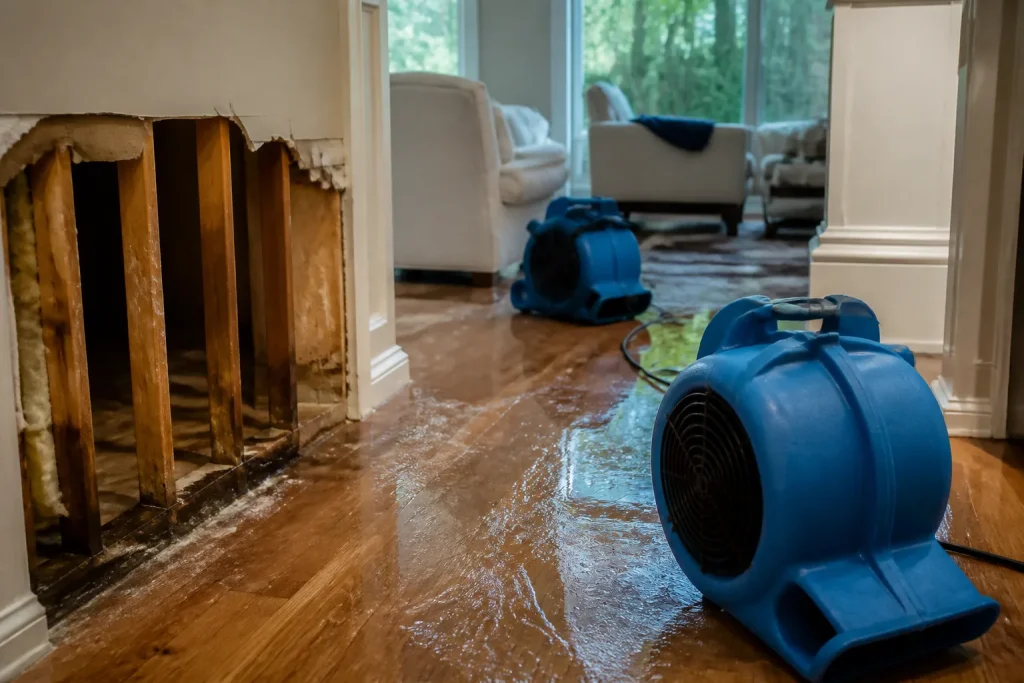
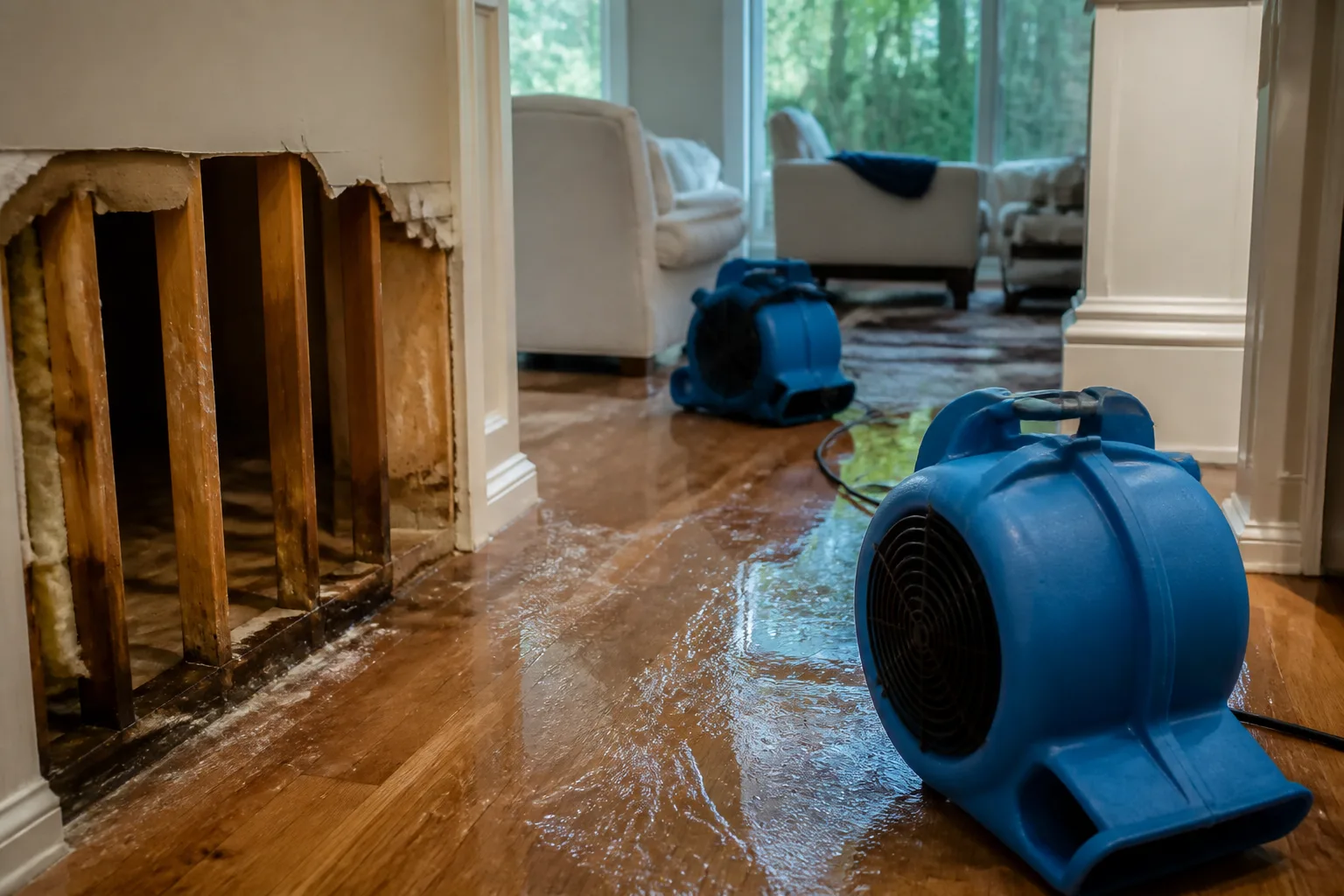
At Floodline Restoration Co., the dispatcher who answers your call is a real person reading from a dispatch board, not a script. The information you give them goes directly to the certified crew loading the trucks, so extraction starts on the first visit. We use professional-grade equipment from Dri-Eaz, Phoenix, and XPOWER, moisture-mapped from day one with daily readings logged until the dry standard is met. The same crew that reads the moisture map on day one handles daily readings, hands the log to the homeowner and the carrier, and rebuilds what needs rebuilding. You don’t get handed off to an “in-network” contractor you’ve never met.
What Happens After the First 90 Minutes: A Real-World Timeline
Once the immediate actions are done, the restoration follows a predictable arc. Here’s what you should expect over the first week.
Hours 2-4: The crew arrives, confirms safety, and maps moisture throughout the affected area. They place extraction equipment and begin removing standing water. The faster this starts, the less water wicks up into drywall and wicks sideways into framing.
Days 1-3: Drying equipment runs continuously. In Great Neck Plaza’s climate, especially in summer, the air outside is often wetter than the air inside. That’s why professional drying uses closed systems with dehumidifiers, not open windows. The crew takes daily moisture readings and adjusts the equipment placement as the dry standard approaches.
Days 4-7: Most clean-water jobs are dry enough for reconstruction by the end of the first week. Gray or black water jobs take longer, because demolition and disinfection happen first and drying follows. We pulled one out of a basement over by the Great Neck Plaza commercial district last month where a sewer line backed up during a storm. The extraction took six hours, the demo took a day, and the drying took five. The homeowner got a moisture log they handed directly to their adjuster, and the rebuild started the following week.
That last part is worth repeating, because it’s where many restoration companies fall short. There’s a moment in every large claim when the damage control is done and the rebuild questions start: “Can the cabinets be saved? When does the trim go back on? Who’s doing the electrical?” If the answer is “a different contractor,” you’ve just inherited a new job. At Floodline Restoration Co., full-cycle means the same certified, background-checked, uniformed technicians handle the rebuild. The line the water left is where we start, and the finished room is where we finish. That’s the whole job, done right, and backed in writing by the 90-Day Done Right Promise, our Keystone Standard.
Insurance In the Room: What You’re Entitled To
Whether your claim is a burst supply line, a sewer backup, or a storm-over-drain event, the insurance carrier expects documentation and a scope of work. You don’t have to be the one gathering it. And in Great Neck Plaza, where older homes often have replacement-cost riders and local building codes that an adjuster in a regional office has never seen, the photo trail you started in the first 90 minutes becomes the foundation of the claim.
Here’s what the carrier will ask for, and what a good restoration contractor should handle for you:
- Moisture readings from before drying started, taken at regular intervals until the dry standard is met.
- An itemized loss list with condition notes, not just a list of rooms that got wet.
- A written scope of work separating mitigation from reconstruction, so the file is clear when the rebuild starts.
- Clear communication with the adjuster, including the moisture log and photo documentation.
If the thought of that paper chase makes you tired, you’re not alone. We handle direct insurance billing and adjuster coordination so you never play messenger between Floodline and the carrier. A square deal: no surprises on the bill.
What Great Neck Plaza Homeowners Should Know About Local Building Conditions
Great Neck Plaza sits on Long Island’s North Shore, which means a few things matter more here than they do inland. The water table is high, which means basements that stay dry for twenty years can flood during a storm because the ground becomes saturated and hydrostatic pressure pushes water through the cove joint where the floor meets the wall. That’s a fact of geography, not bad construction. It also means storm drain backups are more common here than in neighboring towns with newer infrastructure.
Older homes in the village also tend to have cast-iron drain pipes that have been in service since the 1950s or 1960s. When they crack, the first sign is often water appearing in the basement after a heavy rain, not a persistent clog. That’s not a plumbing repair. That’s a water damage restoration job followed by a plumbing repair, and the restoration has to come first to prevent contamination from spreading.
None of this is a reason to fear buying or keeping an older home here. It’s a reason to know who to call when the water shows up. The important thing is to act on the first 90 minutes, not to overthink them.
When to Call a Pro
If the water source is gray or black, call a professional immediately. If the water has reached electrical outlets, a subpanel, or any wiring, call a professional and stay out. If the water covers more than one room, or if it has been present for more than a few hours, the difference between a dry-out and a rebuild is already narrowing.
We’d rather take your call at 2 a.m. and arrive before the problem spreads than take it at 9 a.m. the next morning and be three steps behind. The conversations we have at midnight are the ones where our speed matters most. A live dispatcher answers at (518) 873-4306, every hour of every day, and a certified crew reaches Great Neck Plaza fast. Most jobs are completed in a single visit, using professional-grade extraction and drying equipment, and every job is backed by the 90-Day Done Right Promise.
Related Services in Great Neck Plaza
If the water has been sitting, mold is the next question. Our Mold Remediation in Great Neck Plaza service addresses it before it roots. If the water event followed a fire, the Fire & Smoke Damage Restoration in Great Neck Plaza team handles both jobs together. And for the full scope of what we do, see Water Damage Restoration in Great Neck Plaza.
What happens when you call
- 1
A real person answersNo phone trees - you reach a local pro.
- 2
You get an upfront price rangeHonest numbers before anyone is dispatched.
- 3
A background-checked tech heads outLicensed & insured, dispatched right away.
- 4
You approve before work beginsNothing starts until you say go.
The Bottom Line
The first 90 minutes after water enters your Great Neck Plaza home determine whether you’re facing a drying job or a demolition job. Shut off the water at the source, shut off the power only if you can do so safely, photograph everything in order, and do not open windows, run fans, or disturb standing water before you know what kind of water it is. Tell the restoration company what you know: the source, the timing, the location, and the depth. The crew arrives with the right equipment the first time.
If you’re in Great Neck Plaza and need help, Floodline Restoration Co. offers free estimates. Call (518) 873-4306 any hour, any day. A live person answers, a certified crew shows up fast, and the job is done right, and backed in writing.
Frequently Asked Questions
A live dispatcher at Floodline Restoration Co. answers at (518) 873-4306 at any hour, and we dispatch a certified crew to Great Neck Plaza the same visit, not the next morning. Extraction typically starts within hours of your call, which is the window that matters most for preventing mold and saving flooring.
Most homeowner policies cover sudden and accidental clean-water damage, like a burst supply line or water heater failure. Sewer backup and storm drain overflow often require specific endorsements. The fastest way to find out is to have a restoration company document the loss properly and coordinate with your carrier. Floodline Restoration Co. bills the carrier directly and handles adjuster communication.
Professional drying uses commercial-grade equipment, like Dri-Eaz and Phoenix units, with moisture meters and daily readings that confirm when the dry standard is met. Box fans and consumer dehumidifiers can’t reach the moisture inside wall cavities and under flooring, and in Great Neck Plaza’s humid summers, open windows make the problem worse. If the water spread beyond one small area, call a pro.
If you’ve mopped, used towels, or run a fan, you’ve likely moved water through the house and spread moisture into areas that won’t dry on their own. Don’t keep going. Call Floodline Restoration Co. and we’ll assess what’s still wet, document what happened, and start professional drying from where things actually stand.
Written by Curt Bowman, Owner at Floodline Restoration Co., serving Great Neck Plaza since 2010.
Need Damage Restoration Help?
Call Floodline Restoration Co. - licensed & insured, here with fast after-hours help in Great Neck Plaza.
(518) 873-4306